A weblog for Pete Ellertsen's mass communications students at Benedictine University Springfield.

Sunday, January 29, 2012

If you're curious about jobs, free-lancing, how to tailor your resume, editorial careers, etc., check out Ed 2010 website

It's called Ed 2010 ... that's "Ed" like in Ed, a guy's name, or ed., the abbreviation for editorial. "Ed2010," according to its website at http://www.ed2010.com/, "is a community of young magazine editors and magazine-editor wannabes who want to learn more about the industry so we can fulfill our dreams of landing top editing and writing positions in the magazine industry."

How cool can that be? Well, actually, I don't know for sure. But I Googled into their website when I was looking for a definition to put in our class blog. Ed's blurb for the glossary:
FOB’s and BOB’s and TOC’s, oh my! Here are all the terms to know so you’ll be able to talk the talk.
If you don't know what a blurb is in a magazine, look in the glossary. It'll tell you. I'd never heard of Ed 2010 before, but the glossary is kosher. At least, the definitions match what I've heard in the business. The tips on how to write a resume were pretty sound, too, especially strategies like listing your education last that you'll need to start using as you get away from academic life.

Ed 2010 is like any other website you surf into. Check it out. See what you think. Be careful. (My instinct is to keep reading till somebody asks me to spend money on something, and then I'm out of there.) But it has some information I think you'll find useful.

Especially that glossary at http://www.ed2010.com/resources/glossary. Bookmark it. We'll keep coming back to it. There's another one, but it's shorter.

COMM 353: New reading assignments, week of Jan. 30-Feb. 3

If you think the readings for our practicum in editing are getting pretty strange, just wait. They're about to get even stranger ...

This week I will hand out two excerpts from a book by Nancy Brigham titled "How to Do Leaflets, Newsletters & Newspapers." It's an old book, and the technology is way out of date, but it's the best thing I've ever found on the practical, down-to-earth, everyday reality of getting a publication on the street. Brigham did public relations for the United Auto Workers, and she wrote the book for members of the editorial committees in UAW locals who had the responsibility of getting out a newsletter for rank-and-file members of the local. She speaks from experience. And she is very, very practical.
  • In class Tuesday, we will go over the first handout, which combines snippets on editorial committees, relating to readers, libel and copyright. How does the way she talks about relationships compare to the way Carol Saller talks about them in "The Subversive Copy Editor?"
  • For class Thursday, read Brigham's chapter on planning an issue of a publication. A lot of it is about scheduling and keeping track of copy flow. (What's that mean? Link here for a definition.) How much of this can we use in today's world? More than you might think.
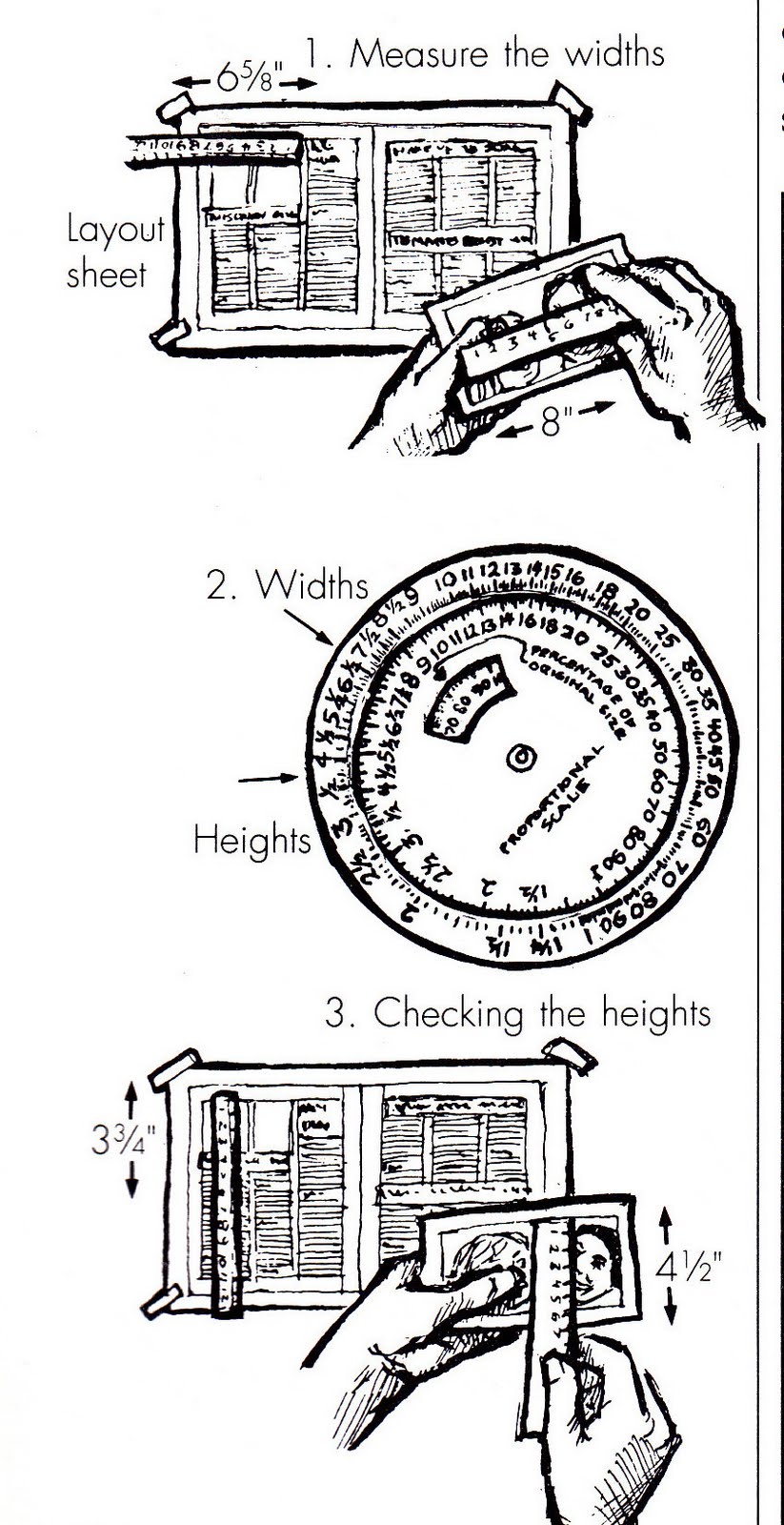
"Leaflets, Newsletters & Newspapers" in an old book, and you'll notice right away that the technology is way out of date.


At left, out-of-date technology used in Nancy Brigham's day to resize pictures instead of dragging the corners in a desktop publishing program. Artwork at right, below, shows two of the steps (out of five or six) involved in resizing a picture (Brigham 162-63).


When Brigham's book came out, the World Wide Web was an experimental program of CERN (the European Organization for Nuclear Research, originally the Conseil Européen pour la Recherche Nucléaire), Windows 95 lay four years in the future, desktop publishing was a trendy new concept that nobody really understood, and people were putting together publications with manual typewriters, scissors, pots of rubber cement, production wheels and "pica sticks," which were metal rulers marked off in a printer's measure called picas. (There were six picas to an inch, and you learned to convert them to inches in your head when you were laying out a page.) Every single technological point that Brigham mentions is obsolete.

But she has the psychology nailed.

In 1991, Brigham coordinated the UAW's Local Union Press Association and conducted workshops for locals around the country. Later on, she designed the UAW's first website and served as webmaster before getting a master's degree in information science from the University of Michgan. She is now a communication strategies consultant and is active in the National Writers Union (UAW Local 1981). So a lot of her examples are drawn from organized labor, but what she says about publishing a magazine is good advice for everybody.

"Leaflets, Newsletters & Newspapers" out of print now, but it's still widely available. Amazon.com has 11 new copies and 60 used copies available, at prices ranging from 1 cent ($0.01) on up. I'd recommend buying it! Even if the technology is out of date, you can still get a penny's worth of use out of the chapters on editorial policy, style, "the facts, finding and using them," interviewing, composing and cropping photos, "writing for the people," editing and layout. She also has tips on things like how to reach your target audience with flyers and what to put in a three-fold brochure that have obviously been tested in the real world. One example:
"The best way to offend readers is to throw at the top of your flyer a screaming headline saying, "Vote for Tom Gallagher!" People who agree with you will nod their heads and walk on, and those who disagree will shake their heads and move on. Many will mumble to themselves: "Who do they thihk they are, telling me how to vote?!"
She'll even suggest what you might say instead, but to find out you'll have to pay your penny and order the book.

If you do, it'll be a penny well spent. Again, Brigham has the psychology of publishing in the real world nailed.

Besides, you can always look at the pictures in the margins of antiquated technologies that we don't have to use anymore! Something like that can bring you a world of comfort when the latest version of Windows is freezing up on you and you're having trouble getting your software to do what you want it to do.

Wednesday, January 25, 2012

COMM 353: What we discussed, decided in class Tuesday

Thanks to Stacie for taking notes on our class discussion Tuesday. Apologies to Stacie for the limited choice of typefaces in Blogger. Otherwise, the notes are just as she typed them up. - pe


Bytes

Zine by Comm Students


Created in QuarkXpress
Benedictine Online Student Magazine

All articles that begin with “What If…” are works of fiction
Literature Section:
“Why You Should Appreciate This” by Van & poem
“Slamming in Springfield” by Stacie
“Poetry” by Robin
Ask Tim about Lit
Sports Section:
“Indoor Hitting” by Glick
“Baseball Season Starter”
“Bump, Set, and Serving Springfield”
Baseball Schedule
See about softball
News Bytes:
“Eastern Garbage Patch” by Stacie
“Something news” by Van
“Something else news” by Stacie

YA KNOW WHAT BYTES?!
Rants, What if’s?, factoids…

COMM 353 b/log 2nd week: Bulldog Bytes ... what's in a name?

mag·a·zine ... n. 1. A periodical containing a collection of articles, stories, pictures, or other features.
2. A television program that presents a variety of topics, usually on current events, in a format that often includes interviews and commentary. 3. a. A place where goods are stored, especially a building in a fort or a storeroom on a warship where ammunition is kept. b. The contents of a storehouse, especially a stock of ammunition. 4. a. A compartment in some types of firearms, often a small detachable box, in which cartridges are held to be fed into the firing chamber. b. A compartment in a camera in which rolls or cartridges of film are held for feeding through the exposure mechanism. c. Any of various compartments attached to machines, used for storing or supplying necessary material.American Heritage Dictionary, http://www.thefreedictionary.com/magazine
We're off to a better start in COMM 353 than I'd expected, and I expected it to be good. As I said the first day, you come well recommended by other faculty and I know some of you from my other classes. I like the working title you chose for the 'zine, and - more important, I think - I like the way you went about choosing it. (I'm saying "you" here because I think I should try to stay out of creative decisions.) I liked the way the discussion went from "bark" to "bite" to "byte," so we can't really say the name was suggested by any one person - it was a group initiative as you riffed off of the first idea and tried out different combinations.

Some of my best decisions have been like that, and they haven't really been mine.

Which may be why they were so good!

(I also like the idea of a magazine as a "small detachable box" full of ammunition. But that's probably because I'm a recovering political junkie, and you can safely ignore it.)

Where should we go from here? What should we do in class Thursday? I've got two things in mind we ought to be doing now.

1. Let's keep filling in details on what we want to put in the magazine. Specific things you guys can contribute ... ideas about artwork, departments or sections, etc. Here's some language for an overall statement that might pull together some of the things you were talking about Tuesday:
... a magazine of the arts, current events, sports and student life."
See what you think of it. Or, better, take it and riff off of it and see if it leads you to something that none of us would have thought of without the group effort.

2. Let's look at other magazines, too. Especially on line. I would never, ever suggest that the youth of America as represented in my classes steal anything. Never, ever. But we can certainly look at other magazines and look for ideas we can use. I'm sure you've heard this: You can't copyright ideas. That's why professional writers keep a clip file of articles they can plunder for story ideas, thing they can adapt and make thier own. (At least it used to be a clip file back in the days of paper clips, or clippings. Now it's apt to be electronic - I do mine with hypertext links like this or this on my personal blog.) Sometimes it's known as a "swipe file" but I would never, ever tell my students to swipe anything.

As you know, I like The New Yorker, and there's some language on their website at http://www.newyorker.com/ about "the New Yorker's signature blend of the arts, entertainment and public affairs." (I'm quoting from memory here. The New Yorker's website isn't particularly easy to navigate, and I can never find the damn quote when I want it.) Even so, they do some things with standing headlines and "dingbats" (the word I use for little graphic elements to mark their departments). It's at least worth looking at.

In a day or two, I'll post a blog question on magazines you read that take the place of what The New Yorker did for my generation. But in the meantime, why don't we look at some of the magazines you read in class?

So Thursday afternoon let's surf around and and find some magazines that we might use as models. What departments do they have? Any other ideas for the "swipe file?" Start with magazines you already enjoy. They don't have to be literary, or college oriented. When you find one that's worth looking at, let me know it address and we can project it up on the screen.

Monday, January 23, 2012

COMM 353: ** UPDATED ** Searching for a theme for our (magazine, anthology, what's the best word for it)? BULLDOG BYTES

Editor's Instructor's note - Since I've asked you to email me with your list of possible articles and/or thoughts about possible articles, I have updated this blog entry and plan to keep updating it as your messages/lists/thoughts keep coming in. Until we get something more formal (and foolproof) to track copy flow, etc., this post as updated can serve as one of several informal logs of what we're got for the Bulldog Bytes project. - pe

This week in class ...

Let's see what we've got for our publishing project, and start thinking about how it can all fit together. I like what I'm hearing from you about wanting a theme for the thing. (Let's find a good word for what to call it, too. "Publications project," to quote the catalog description, or "demonstration magazine" are the best I've come up with so far. But we can do better than that!) So far I've only heard from a couple of you ... although I may have inadvertently deleted some others from my inbox ... but I think we're off to a good start.

A couple of things are clear already. We've got a wide range of talents and interests represented in the class, so we'll want to reflect that diversity in the project. I hope we can get a mix of literary stuff, both poetry and prose, as well as creative nonfiction, personal essays, sports, public affairs, whatever. When I worked with SCI's campus magazine, a lot of what we called "creative nonfiction" looked a lot like student papers! I don't want to rule anything out yet. Pictures, graphics, art. Let's just see what we've got, get all our ideas up on the table and take it from there.

I'll copy below the messages I've gotten so far.

And below them I'll include a mission statement from the old Sleepy Weasel that might be helpful.

After I asked you Thursday to let me know what you can conribute, I got two email messages. The first came in at 3:30 p.m. the same day. Stacie wrote:
When I was searching for ideas to "borrow" for our magazine I came across several sentences -or ideas- that I felt fit what we might be trying to do. I think we are going to see a lot of variety with our submissions but within this variety I think we will find many themes. One student magazine said that they primarily focus on campus news, sports, events, people and issues, but coverage also branches out to community, state, national and international stories. Now I think every submission will fit into one of these categories and I think that means we have ourselves a magazine! Seeing as how we have several creative writers in the class I think it would be great to include like a "featured lit" section of the magazine. I am very excited about this project Doc!

These are several of my "copies":
  • "Bump, Set, and Serving Springfield"- This is in a way a biography of a Benedictine student. I feel like this would fit into a "featured students" or "student interests" section of the magazine. It is less than 400 words.
  • "Slamming in Springfield"- This is a feature article on slam poetry. It features the accounts of John McCarthy, a BenU student. This would also fit into a "featured students" or "student interests" section of the magazine. It is about 900 words.
  • "Plastic Island on the Move"- This is an article on the "Eastern Garbage Patch." It is about 600 words. This would fit well into the news section of the magazine.
And the second came in at 8:49 that night ... John wrote:
In regards to the content of this magazine. I have a chronic case of not saving things and throwing writings over the place. I suppose it is the Keats in me. I have a few odd poems from some creative writing classes that I don't plan on doing anything else with, but I was thinking about the eclectic approach this magazine is headed. I was wondering if we could assign positions. From there a managing editor could assign assignments from there. (Run this like the bulldog used to be run, sort of.) I am fond of the New Yorker/ New York Times approach with designated sections on individual topics: entertainment/books/politics/economics/etc. Each person could write a different article, and we could take turns editing different articles so we all get the same experience but a more direct and coherent publication. Just my thoughts. See you Tuesday.
Here's the mission statement from the old Weasel, copied from a blog post about COMM 353 that I put up in December when it was clear the course would be offered this semester ...
The Sleepy Weasel is a campus magazine of the arts and public affairs published by students and faculty of Springfield College and Benedictine University, on the World Wide Web at and in hard-copy format at the College's campus in Springfield. The Weasel seeks to highlight written and artistic work by our students, both in and out of class, and to help promote a sense of community on campus by providing a voice for the creative work of students, faculty, staff, alumni, and others in the Springfield-Benedictine community.
Our project will be quite a bit different from The Weasel, but it may be helpful for you to know what's been in the back of my mind as I started planning COMM 353 project. It also has a picture I like of a ... well, not exactly a sleepy weasel but a clip-art ferret perched on a stack of books. I do like the stuff in the mission statement about promoting a sense of community on campus, but I want this to be your project, and I don't want to dictate too much.

UPDATE ** Tuesday night ** MORE COPY

Van wroate, today at 3:05 p.m.: " I don't know if we can use any of these things as articles in Bulldog Bytes, However, untill I revive my computer, this (and the few scraps in my email, or my blog) is all that have at the moment." Attached were:
  • "A Death Dealer’s Day." Analysis of a story by Sarah McCoy.
  • "A Tangled Web: The Mind of Hamlet." Analysis of a play by some English author.
  • "Cardio Kickboxing was a trend in the 90’s, but in the 21st century, the fists are flying as fast as ever." Profile.

Wednesday, January 18, 2012

What do writers, editors, "mega-curators" and street hustlers have in common in a digital age? And how can you "design your own profession?"

This from Anne-Marie Slaughter, a politics and international affairs professor at Princeton University. From 2009 to 2011 she served as director of policy planning for the U.S. State Department.

In a recent blog for the Harvard Business Review titled "Design Your Own Profession," Slaughter writes that with the digital revolution in full swing, "many old titles and jobs no longer make sense, and many new functions are just waiting to be claimed." She says:
Between the reporter and the editor is now an entire layer of verification functions. Top magazines have always had "fact-checkers": the New Yorker is famous for theirs. But traditionally the verification of facts reported in a newspaper was performed by the reporter and his or her editor. Considering the countless information streams that can produce a set of facts for any particular story these days, media outlets need "verifiers" who are expert at cross-checking information coming from different sources and assessing the credibility of individuals on the ground. Andrew Carvin, a senior NPR strategist who has become one of the principal digital curators for tweets and posts coming from the ground in the Middle East revolutions, is invaluable in part because he has developed the expertise to evaluate the credibility and accuracy of live sources.

One level up, editors are not only super-storytellers but super-curators, figuring out what streams of information should weave together on the website and in actual stories. Publishers are not producers of one finished stream of information but aggregators of many, from raw to polished.
Well, that's a pretty good description of the megatrends. But how can this information be useful to students in journalism, writing and publishing? Slaughter frames the question like this:
So what does all this mean for job-seekers in this uncertain economy? Forget the titles on the org charts and the advertised positions. Design your own profession and convince employers that you are exactly what they need. In my view, the New York Times and other information hubs ought to be advertising for curators and verifiers, but you shouldn't wait for them to do so. Define the functions you think they need and you can supply, and then apply for a corresponding position, whether or not they've created it yet.
This advice isn't anything terribly new. I remember being inspired when I was in grad school, as I read in a book called "What Color Is Your Parachute?" that you create your own job description.

I'm not sure it always worked like that, but all of us were well aware you had to have the instincts of a street hustler in order to survive in the arts. (I'm counting journalism as an art here.) And successful street hustlers have always had something of the artist in them, right? That was true in the 1970s, and it's even more true now. Read the rest of Slaughter's blog. It may not land you a job, but it can get you thinking along lines that will.

Thanks to Associate Academic Affairs Dean Joanna Beth Tweedy for showing me Slaughter's post.

COMM 353 - b/log - Week 1

Note to students: I'll be blogging along with you in class, at least in the beginning of the semester, partly as an example of I how go about using the medium to develop my voice as a writer. (Think of it as a voice exercise, like singing do mi sol do sol mi do as a warmup.) You certainly don't have to sound like me. But I encourage you to use your own blogs to exercise your own voice. Blogging is a form of publication, but it's provisional, transitory, written on the run. It isn't a finished product, and doesn't pretend to be. So take advantage of that freedom as you write your own blog. - pe

Getting started ...

In the tentative calendar, I assigned for the first week:
Writing: On your own blog, answer these questions, among others I will post to The Mackerel Wrapper. What can you learn from the two introductions [to the books we'll read this semester] that you can use in your writing and editing career? Who’s blogging for the New Yorker’s website these days? What is their slant on things? What are their backgrounds? What can you learn from them?
Some of that we'll do in class Thursday. But I just went flipping through the introductions. And here's a couple of things I learned.

From Carol Fisher Saller, "The Subversive Copy Editor" I get the following:
  • Saller deals a lot with the nits we pick under the heading of "grammar," but she isn't concerned primarily with the picking grammatical nits. She certainly does like footnotes, though. Some of that freshman English-y stuff you never get away from. Even it isn't what's most important.
  • She certainly does get a lot of questions for the Q&A column at University of Chicago Press. And - guess what? - the questions are about "grammar." That's what the general public thinks about when they think about editing. I guess it's something we all have to get used to.
  • Saller tips her hand, says what she's doing. (Which is why I assigned the intro.) Says it flat out: "You won't learn the fundamentals of copyediting from me. Rather, consider this a 'relationshp' book, because I'm going to talk about the main relationships in your work life - with the writer, with your colleagues, and with yourself - in ways that you might not have considered before. Ways that might be considered subversive."
  • A grammatical nit: I'm noticing Saller uses the "Oxford comma," that comma before "and" in a series - and I'm going to have to get used to it. Associated Press style omits it. University of Chicago keeps it in. My favorite example of why to use it (even though I usually don't) is the hypothetical book dedication to "the people whom I admire the most, my parents, Mother Theresa and the Pope."
  • Back to relationships, and what I consider the collaborative nature of editing. I really like this: "Who knows? If we're lucky, in the course of figuring out some strategies for getting along with our authors, our bosses, our colleagues, and ourselves, we might also happen to learn something about getting along in life."
You'll no doubt find other things you like - or don't like - about Saller.

And these are some of the things that struck me in James Thurber's "The Years With Ross" about the early glory years of the New Yorker under founding editor Harold Ross:
  • First thing I learn right off the bat: I really ought to go back and look at the damn book before I write out assignments! This book doesn't have an "introduction." It has forewords. A couple of them. The first, and most important, is by the New Yorker's cultural affairs writer Adam Gopnik.
  • Gopnik tells us what to look for in the book, too. Here's one thing: "... the story it tells [is] about how writers and editors together, in the years between [World War I Gen. John] Pershing and Pearl Harbor, made a new kind of American music ... a style emerged that still strikes a downbeat for most good American writing today." Gopnik is using "music," of course, as a metaphor from writing.
  • And this: "... there is something permanent in The Years with Ross about how a writer learns to write, what an editor can teach him, and how the tone they shape together can be around for other writers when both of them are gone."
  • A comment about Thurber, but it applies as well to the "music" or prose style that The New Yorker did so much to develop: "No one worked harder or went further to slim down the space between American speaking and writing voices, between the way we talk and the way we write."
  • Gopnik writes for The New Yorker, and he says that style survives today. "Those of us who draw our paychecks at that particular window think it still goes on at the magazine itself, and we knock ourselves out trying to make sure it can. But it doesn't belong to us any more than it ever did. ... I sometimes think of Thurber's late, lovely fable of the last flower, where the world contines because one man, one woman, and one flower are left after the Apocalypse to continue it. Ross's years, Thurber's tone, will go on, I blieve, if there remains onlyh one weird and moving fact, one writer to point at it, and one reader to take heart at its presence."
Notice how the world wars, WWI and WWII, defined the New Yorker's moment in history? What defines our moment in history in the early years of the 21st century? How is it different? How is it the same?

An animated version of "The Last Flower," Thurber's cartoon fable published in November 1939 (two months after the outbreak of World War II), is embedded below. There's a very nice soundtrack to the YouTube clip, but it isn't Thurber's. He drew "The Last Flower" as cartoons on the printed page. So after a minute or so I turned the soundtrack off.

Sunday, January 15, 2012

comm 353 syllabus

SPRING 2012 --
INSTRUCTOR: Pete Ellertsen -- 2125 S Lincoln Ave, Spfld
eellertsen @ ben.edu (copy and paste into address field and delete spaces)
Dawson 220 -- 2:30-3:45 TR

I. COURSE DESCRIPTION:

COMM-353 (3). Advanced Seminar in Writing, Editing and Page Design for Publications. In this seminar, students work on a major publications project, engage in critical reading of media content, discuss writing, editing and page design strategies, have drafts of their work critiqued in class, and develop a professional portfolio of the work. Prerequisite: COMM-150, COMM-207, COMM-208 and COMM-209.

II. TEXTBOOKS. (1) Carol Fisher Saller, "The Subversive Copy Editor: Advice from Chicago" (Chicago, 2009). ISBN 978-0226734255. (2) James Thurber, "The Years with Ross" (ed. Adam Gopnik, HarperCollins Perennial Classics edition, 2001). ISBN 978-0060959715. We will keep up with The New Yorker’s website at http://www.newyorker.com/ and read selected articles therein assigned by the instructor and/or suggested by students. The Associated Press Stylebook will be used as the stylebook for the course. Optional but also recommended are: “The Chicago Manual of Style” (15th or any recent edition, used copies widely available on line); and Ben Yagoda, “About Town: The New Yorker and the World It Made” ISBN 0-684-81605-9.

III. MISSION STATEMENT OF BENEDICTINE UNIVERSITY. Benedictine dedicates itself to the education for the undergraduate and graduate students from diverse ethnic, racial and religious backgrounds. As academic community committed to liberal arts and professional education distinguished and guided by its Roman Catholic tradition and Benedictine heritage - the University prepares its students for a lifetime as active, informed and responsible citizens and leaders in the world Community.

IV. GOALS, OBJECTIVES, AND STUDENT LEARNING OUTCOMES

Degree Program Goals

The Communication Arts degree program goals are as follows:

1. Prepare graduates for careers in advertising, electronic and print media, journalism, public relations, publishing, writing or other careers requiring sophisticated communications skills;
2. Prepare graduates for continued study in graduate or professional school;
3. Develop the student's critical and imaginative thinking, reading and writing skills;
4. Develop skills to empower the student to communicate ideas effectively, through speaking, writing and the use of technology;
5. Develop skills for critical interpretation of the media;
6. Foster aesthetic understanding in both production and interpretation of media texts;
7. Develop knowledge of the methods to make responsible social and personal decisions;
8. Develop primary and secondary research methodologies;
9. Develop an understanding of the history, structure and operation of the mass media;
10. Provide an understanding of the impact of mass media industries and messages on the individual, society and culture;
11. Develop professional-level skills in written and oral communication for a variety of media and audiences;
12. Develop professional-level production skills for both print and electronic media;
13. Encourage the development of creative expression; and
14. Help the student develop a professional media portfolio.

B. Course Goals

• Students will apply basic editorial principles, attitudes and practices in academic and quality magazine settings
• Students will gain practical editing experience on a demonstration literary magazine,
• Students will gain metacognitive knowledge of their experience and its relation to the practices and principles detailed in their readings
• Students will have their work included in a juried piece suitable for inclusion in their portfolios

B. Course Objectives/Outcomes

As a course requirement within the degree program, COMM 353 was designed with the above goals in mind. Thus, upon successful completion of this course, the student will be able to demonstrate mastery of the following objectives and student learning outcomes:

• Students will apply specific editing, production and critical thinking skills required in the preparation of articles and art for publication and in the production of a "little" magazine of literature, the arts and public affairs.
• Students will refine their critical thinking and professional standards and sense of craftsmanship by reading about 20th-century editorial principles and processes; applying principles to the present media environment; and editing each other’s work for a group portfolio piece.

V. TEACHING METHODS. COMM 353 is designed as a practicum, i.e. a course in which students apply the principles learned in their prerequisite courses, as well as areadings throughout the semester, to the writing, editing and production of a demonstration literary-type magazine.

There are two major components of the course:


1. [Lab magazine.] Students will contribute between three and five written pieces to the magazine, and between one and three pieces of artwork, i.e. visual or graphic work; edit and critique each other’s copy; and prepare all copy for publication. Contributions to the magazine can be work that was preciously submitted in other classes. The finished demonstration magazine will be submitted to outside jurors for evaluation, and the instructor will supervise, mentor and evaluate students during the editing and production phases, and assign final grades to students.

2. [Reading and reflection.] Students will read an introduction to editorial principles, attitudes and procedures by a line editor at the University of Chicago Press and a biography of the founding editor of The New Yorker. They will write essays and Web log (blog) posts reflecting on the craft agenda, attitudes and procedures of the Chicago press and the New Yorker, and apply these principles to current demands on media professionals both in print and on-line platforms.
Embedded questions in test instruments and essay assignments will be used for assessment of learning outcomes.

Students please note: Participation and class discussion are the keys to your success in this course. Be prepared to discuss the weekly reading assignments and contribute thoughtful, topical questions and comments about the material both in face-to-face class meetings and on your blogs. Please be considerate and respectful of one another. Web logs evaluated for course credit in my classes comprise a virtual community and an electronic extension of my classroom. In asking students to post to blogs, as in all of my classes, I encourage you to think for yourselves and try out new ideas; to do that safely, we have to respect and trust each other. Therefore, I must ask that we refrain from negative personal comments or "flame wars" on line. What sounds like friendly kidding when we're F2F (face-to-face) with each other can look hostile and intimidating in writing. Distractions in class will not be tolerated (e.g. disrespectful interruptions of instructor, guest speakers, fellow students, cell phones, and discussions irrelevant to class topics) and can affect your grade. Comments or concerns about specific material presented by the instructor or fellow students (should a student be dissatisfied or concerned) need to be brought to the instructor’s attention before or after class.

VI. COURSE REQUIREMENTS, READINGS, WRITTEN ASSIGNMENTS AND TESTS

A. Attendance Policy.
Attendance is required during all class sessions. Students may miss no more than 10 percent of classes without penalty. Unexcused absences in excess of 10% will result in a reduction of the final grade in direct ratio accordingly. For example, an absence percentage of 17% will result in a reduction of the final grade by 7%. If you must miss a class for legitimate reason – e.g. illness, a child care emergency, jury duty or military duty – you must notify me ahead of time or, in the case of an emergency situation that arises without forewarning, within a reasonable period of time as soon as you are able to contact me. I will attempt to arrange make-up work in the case of a bona fide emergency, but the editing processes involved in COMM 353 are collaborative, and your absence will hurt not only your own performance in the course but also that of your classmates. If the final exam is missed for any reason, it may not be made up. If the absence occurs on the date an assignment is due, the late penalty for assignments still applies.

B. Reading Assignments, Please see the discussion of textbooks above and the tentative calendar below for reading schedule. You are expected to complete readings by the assigned dates and to turn in reflective essays on or before the dates assigned in the syllabus. You will keep up with The New Yorker’s website on a weekly basis. In addition to the readings outlined below, you may be given additional reading assignments including articles, journals, websites, etc. Quizzes and/or tests may cover any of the assigned readings or discussions.

C. Written Assignments and Tests. In addition to writing and editing the material in the demonstration magazine, students will write: (1) two five- to eight-page essays discussing selected issues raised in the assigned readings, with particular attention to how they can incorporate the attitudes, practices and procedures in their own writing; (2) a weblog in which they post weekly updates reflecting on issues raised in their assigned reading and their experience in editing and producing the magazine; (2) a midterm essay examination over the “Subversive Copy Editor” textbook; and (3) a five- to eight-page self-reflective essay at the end of the semester in which they evaluate their perceptions of the course material and its impact on their writing and editing. All assignments are due on the date indicated in the tentative calendar, and must be emailed to the instructor or posted to your blog by the beginning of class on the Thursday of the week during which they are due.

Benedictine University at Springfield Student Academic Honesty Policy
The search for truth and the dissemination of knowledge are the central missions of a university. Benedictine University at Springfield pursues these missions in an environment guided by our Roman Catholic tradition and our Benedictine heritage. Integrity and honesty are therefore expected of all University students. Actions such as cheating, plagiarism, collusion, fabrication, forgery, falsification, destruction, multiple submission, solicitation, and misrepresentation are violations of these expectations and constitute unacceptable behavior in the University community.

Student’s Responsibility
Though there is no formal honor code at Benedictine University at Springfield, students are expected to exhibit academic honesty at all times. Violations against academic honesty are always serious and may result in sanctions that could have profound long-term effects. The final responsibility for understanding the Academic Honesty Policy of the institution, as well as the specific policies for individual courses normally found in syllabi, rests with students. If any doubt exists about what constitutes academic dishonesty, students have the responsibility to talk to the faculty member. Students should expect the members of their class to be academically honest. If students believe one or more members of the class have been deceitful to gain academic advantage in the class, students should feel comfortable to approach the faculty member of the course without prejudice.

Violations of the Academic Honesty Policy will be reported to the Office of the Dean of Academic Affairs. Along with a verbal warning, the following are consequences a student may face for academic dishonesty:
• a failing grade or “zero” for the assignment;
• dismissal from and a failing grade for the course; or
• dismissal from the Institution.

VII. MEANS OF EVALUATION.

The instructor's grading scale is as follows: A = 100-90. B = 89-80. C = 79-70. D = 69-60. F = 59-0.

Written work will be graded for mastery of student learning objectives as evidenced by an evaluation of content, including clarity of thought and the use of relevant detail to support the student's conclusions. A final examination will be given, consisting of essay and short-answer questions, which will be evaluated for content. Quizzes and in-class journal exercises may be assigned without notice at the discretion of the instructor. Contribution to class discussion and participation in on-line research exercises in class will weigh heavily in each student's grade. Final grade weighting is as follows:

WEIGHTING


  1. Student blogs and class participation – 25 percent

  2. Demonstration magazine – 25 percent. This will be a group grade, based in part on outside jurors’ evaluations.

    Essays – 50 percent


  3. a. Midterm -- on “Subversive Copy Editor”
    b. Reflective essay on “Years With Ross”
    c. Self-reflective essay (in lieu of final exam)
If a student believes that an error has been made in reporting a grade, an appeal must be made in writing to the instructor and must be initiated 90 days prior to the end of one semester after the course in question has been completed. The appeal should contain specific information on why it is believed the grade reported is inaccurate. See the Student Handbook for details.

Add/Drop Dates
Please refer to the current Academic Calendar for add/drop dates.

Incomplete Request
To qualify for an “I” grade, a minimum of 75% of the course work must be completed with a “C” or better, and a student must submit a completed “Request for an Incomplete” form to the Registrar’s Office. The form must be completed by both student and instructor, but it is the student’s responsibility (not the instructor’s) to initiate this process and obtain the necessary signatures.

Student Withdrawal Procedure
It is the student’s responsibility to officially withdraw from a course by completing the appropriate form, with appropriate signatures, and returning the completed form to the Advising Office. Please refer to the Student Handbook for important financial information related to withdrawals.

VIII. COURSE OUTLINE AND/OR CALENDAR.

A. The “how” of editing – principles and procedures


1. Working with writers
2. Collaborative nature of editing
3. The zen of editing
B. The “why” of editing – editorial standards, New Yorker case study

1. Literary role and standards
2. Journalistic role
3. Relevance to 21st century?
C. The day-to-day reality of editing – applying the “how” and “why”


1. Editorial standards
2. Professional standards
3. Personal standards
Please see also the tentative calendar below.

IX. AMERICANS WITH DISABILITIES ACT. Benedictine University at Springfield provides individuals with disabilities reasonable accommodations to participate in educational programs, actives and services. Students with disabilities requiring accommodations to participate in class activities or meet course requirements should contact the Director of the Resource Center as early as possible.

If documentation of the disability (either learning or physical) is not already on file, it may be requested. Once on file, an individual student’s disability documentation is shared only at that individual’s request and solely with the parties whom the student wishes it shared. Requests are kept confidential and may be made by emailing jharris@sci.edu or by calling 217-525-1420, ext. 306.

X. ASSESSMENT. Goals, objectives, and learning outcomes that will be assessed in the class are stated in this syllabus in Sections IV and VI. Instructor will use embedded questions in graded writing, background knowledge probes, one-minute papers, reflective essays and/or other Classroom Assessment Techniques as deemed necessary in order to provide continuous improvement of instruction.

TENTATIVE CALENDAR

Week 1 (Jan. 17-19)
• Reading: Saller, Intro (ix-xvi) and Thurber, Intro by Adam Gopnik (ix-xxix). Survey the New Yorker’s website at http://www.newyorker.com/.
• Writing: On your own blog, answer these questions, among others I will post to The Mackerel Wrapper. What can you learn from the two introductions that you can use in your writing and editing career? Who’s blogging for the New Yorker’s website these days? What is their slant on things? What are their backgrounds? What can you learn from them?
• Editing: We will begin the process of planning a demonstration magazine, as described in the syllabus above.

Week 2 (Jan. 24-26)
• Reading: Saller, Part I “Working with the Writer, for the Reader” (3-53). Keep up with the New Yorker at http://www.newyorker.com/. What’s new this week? Does your perception of it change as you become more familiar with it? If so, how?
• Writing: Keep up your own blog. It should begin to take on a journal-like quality as you read the assigned texts, follow the New Yorker on line, begin to work on pulling together a demonstration magazine and reflect on how you might be able to use what you’re learning in our own career.
• Editing: Choose examples of your own writing you wish to have included in the magazine. We need three to five written pieces and one to three pieces of artwork and/or graphic design from each of you.

Week 3 (Jan.31-Feb. 2)
• Reading: Saller, Part II “Working with your Colleagues, and With Yourself” (55-102). Keep following the New Yorker’s website at http://www.newyorker.com/.
• Writing: Keep blogging.
• Editing: We should be well into the planning stages now, making realistic decisions about copy flow, deadlines and the assignment of duties. While I will have suggestions for you based on my experience as faculty adviser to the old Sleepy Weasel, you will be responsible for making the magazine happen.

Week 4 (Feb. 7-9)
• Reading: Saller, Chapters 10, 11 and Appendix, on free-lancing, the Zen of editing and “breaking in” (103-119). Keep following the New Yorker’s website at http://www.newyorker.com/.
• Writing: Keep blogging. I will assign the midterm over Saller. It will be a take-home essay examination, due in class Thursday, Feb. 16.
• Editing: By now we should have a rough idea of our production schedule and deadlines. We need to “crash” the magazine and take it through final edit by the week of April 17-19 in order to get it in the hands of jurors, i.e. outside readers who will evaluate it and help determine the final grade for the group project. So we will have to work back from there.

Week 5 (Feb. 14-16)
• Reading: Thurber, ix-35 (this includes reading Thurber’s foreword and re-reading Gopnik’s, which may give you some indication of how important I think it is). Keep following the New Yorker’s website at http://www.newyorker.com/.
• Writing: Keep blogging. As you start reading Thurber, ask yourself how this story of a very idiosyncratic guy who founded a magazine nearly 100 years ago can have any relevance to our world of bewildering change in media. Blog about it. Keep it in mind as you read on.
• Editing: Have copies of your contributions to the magazine ready to be reproduced and edited by other members of our editorial group. As we begin the process, we will have to figure out a foolproof system for identifying who has edited a piece of copy and which is the final version that goes in the magazine.

Week 6 (Feb . 21-23)
• Reading: Thurber, 36-99. Keep following the New Yorker’s website at http://www.newyorker.com/. As you read more of Thurber, you’ll notice he isn’t exactly writing a straight biography. He’s tricky. What’s his attitude toward Ross? How does he convey it? What can you learn about editing – and about writing – from reading it? Are there principles and practices, tricks, techniques or odd little bits of information you can apply you own career?
• Writing: Keep blogging about your experience and your reading. My questions under the reading assignments are intended to be blogworthy, and you should address them in the blog.
• Editing: We will schedule “workshop” discussions of your contributions and your edits in class.

Week 7 (Feb. 28-March 1)
• Reading: Thurber, 100-120. Keep following the New Yorker’s website at http://www.newyorker.com/. How were the outsize personalities and towering egos of the people who worked with the New Yorker able to mesh in a collaborative manner? Can you infer any psychological and/or management principles from Thurber’s account? Or are these just long-dead personality issues?
• Writing: Keep blogging. As we compare edits and try to come to a consensus on different pieces of writing, what insights do you get from the process into the collaborative nature of writing and editing? Of preparing work for publication?
• Editing: Workshop discussions begin.

Week 8 (March 6-8)
• Reading: Thurber, 121-154. How did the New Yorker’s editorial product change from the “roaring 20s” to the Great Depression, World War II and beyond? How did Ross change? Or did he?Keep following the New Yorker’s website at http://www.newyorker.com/.
• Writing: Keep blogging. What insights from the long-ago historical periods that Thurber writes about can offer you guidance for the second decade of the 21st century?
• Editing: Workshop discussions continue.

Week 9 (March 13-15)
• Reading: Thurber, 155-211. Keep following the New Yorker’s website at http://www.newyorker.com/.
• Writing: Keep blogging. How, in your opinion, does the New Yorker today compare to the magazine of the early 20th century as James Thurber described it?
• Editing: Workshop discussions.

Spring Break (March 19-25)

Week 10 (March 27-29)
• Reading: Read Thurber, 212-72. As you finish “The Years With Ross,” you’ll notice the tone becomes almost elegiac. What does it tell you about Ross? About Thurber? About the collaborative nature of publishing? Keep following the New Yorker at http://www.newyorker.com/.
• Writing: Keep blogging. I will assign you an essay reflecting on Thurber’s biography of Harold Ross and its applications, if any, to today’s world.
• Editing: Workshop discussions.

Week 11 (April 3-5)
• Reading: Keep following the New Yorker’s website at http://www.newyorker.com/.
• Writing: Five- to eight-page essay on “Years With Ross” due Thursday, April 5 (grace period to Tuesday, April 10).
• Editing: Copyfitting and layout.

Easter Recess (April 6-9)

Week 12 (April 10-12)
• Reading: Keep following the New Yorker’s website at http://www.newyorker.com/.
• Writing: Grace period expires on Thurber essay. Keep blogging as we start crashing the magazine.
• Editing: Copyfitting, layout and last-minute crises.

Week 13 (April 17-19)
• Reading: Keep following the New Yorker’s website at http://www.newyorker.com/.
• Writing: Keep blogging, crashing and more blogging.
• Editing: FINAL EDIT

Week 14 (April 24-26)
• Reading: Keep following the New Yorker’s website at http://www.newyorker.com/.
• Writing: Keep blogging. I will assign final self-reflective essay.
• Editing:

Week 15 (May 1-3)
• Reading: Keep following the New Yorker’s website at http://www.newyorker.com/.
• Writing: Self-reflective essay due.
• Editing:

Last Day of Classes (May 5).
Final Exams (May 7-12). Our exam period TBA.

Thursday, December 08, 2011

COMM 150: Last day of classes

Some last points about our subject matter in COMM 150, and a couple of housekeeping matters relating to the final exam, grades, etc.

  1. Some information on copyright is posted below. Click here to open a new window, or just scroll dow to the next item. Bottom line: You don't have to worry about copyright for school, since you're covered by the "fair use" exemption for educational purposes. But if you publish anything away from school, including on your own blog, you have to be careful. My quick-and-dirty post tells you how to be careful.
  2. Your final exam is posted below. Click here if you want to see it in a new window, or just scroll down a couple of posts.
  3. If you have a solid A in the class, you don't have to take the final. See me after class. If I don't have all your papers, see me after class. If you're not sure what's going on and don't know where you fit in, see me after class.
  4. I like to close my classes with a YouTube video (which of course I'm using under the "fair use" copyright exemption for educational purposes, right)? This semester's is embedded below.

"Hallelujah Chorus," Christmas Food Court Flash Mob

Earlier this semester we watched a "flash mob" organized by the Copenhagen Philharmonic in Denmark. This flash mob, in a shopping center food court in Canada, was also superbly organized, choreographed and recorded by Alphabet Photography of Niagra Falls, Ontario. To read more about the agency, link here to their About Us page. Cooperating were Robert Cooper and Chorus Niagara, The Welland Seaway Mall and Fagan Media Group. According to its website (which features a picture from the flash mob, "Fagan Media Group integrates the strengths of like-minded associates who believe in quality production values and captivating content, offering a one-stop portal for all media services including, broadcast, corporate, website, social media and software design." They certainly demonstrate quality production values in the food court video project.


Some of you may also consider the message of the song appropriate to the end of the semester.

COMM 150: A quick-and-dirty guide to copyright law for journalism students

It pays to know something about copyright.

For example, country singer Willie Nelson sold his rights to a song called "Family Bible" for $50 when he was just starting out in Nashville. He needed the money right away. But over the long run, he got screwed blue. Don't laugh. The song has been worth millions in royalties over the years.

But not for Willie Nelson.

Let's give it a working definition: "Copyright" boils down to this, it's the right to make a copy of something you created. Most of the stuff that most of us write - that would include me, by the way - isn't worth enough money to copyright. Sad, but true. Worrying too much about copyright, e.g. registering your rhymed verse about Aunt Gertrude that begins "Roses are red, violets are blue / Aunt Gertrude rocks, / Through and through" with the U.S. government can be interpreted as the sign of an amateur.

For an unusually clear introduction to the whole copyright schmear, go to the Washington State University copyright page at http://publishing.wsu.edu/copyright/ ...

Some points for writers (that would be us), distilled from Washington State and elsewhere:a

  • You don't have to register a work with the Library of Congress anymore. You just publish it. "Publish," by the way, means something different in copyright law than it does in libel law. In this case, it is "the distribution of copies or phonorecords of a work to the public by sale or other transfer of ownership, or by rental, lease, or lending. " Job tip: Little inconsistencies like that make work for lawyers!
  • It's still a good idea to register with the Copyright Office of the Library of Congress. Its Web site at http://www.copyright.gov/ tells how.
  • Books should be registered with a company called Bowker, which issues them an International Standard Book Number (ISBN) and gets them listed in an authoritative catalog of "Books In Print" available at most libraries (including Becker) and on line.
  • When you sell an article to a magazine, they buy the right to copy it unless you specifically negotiate secondary rights. If you write something on the job, the law assumes you assign all rights to your employer unless you negotiate a more favorable arrangement. That arrangement is called "work for hire," and it's what most professionals are bound by.


Some points for users of copyrighted material. Copyright infringement, unlike plagiarism, is a violation of the law. It is similar to plagiarism in that it consists of the use of another person's intellectual property without permission. It is different in that you can be sued if you violate copyright. [Also see the footnote about fair use and plagiarism below.] The practices you learned in school about avoiding plagiarism, however, will help you avoid infringement. Giving credit, not quoting too much, etc. Here are some things I learned on the job:

  • Be very, very careful with the words to songs. Best bet: Always seek permission to quote song lyrics, and never quote more than two or three lines. stuff. Musicians and recording companies are most vigilant about protecting their copyright because the words to a hit song, obviously (think about it), have value.
  • If you're publishing to the Internet, for example blogging, be very careful. (Are you beginning to see a pattern here?) You can link to other pages without permission, but if you want to copy their stuff, email them and obtain permission first.
  • Seek permission for anything you use. See the pattern?
  • Some stuff is copyright free. Examples: U.S. government documents (but not necessarily state government, so be careful). An interesting development in Web publishing is Creative Commons licensing. It's not really mainstream yet, but it's especially useful for bloggers. There's a post on how I use Creative Commons on the Mackerel Wrapper for March 31, 2009.
Two big exceptions for journalism students fall under the legal doctrine of fair use (which is not the same as fair comment in libel law). Fair use, according to Wikipedia, "... allows limited use of copyrighted material without requiring permission from the rights holders, such as use for scholarship or review." And covering the news.

So if you're writing a review of a published work for publication, you can quote from it under the doctrine of fair use. (You can say mean and nasty things about it under the doctrine of fair comment, but that's another issue.) Practically everything you write for class falls under fair use, because it's considered scholarship. But if you publish your old term paper, you have to secure permission for extended quotation, pictures and other intellectual property.

Footnote on plagiarism. Quoted from Wikipedia's discussion of fair use: "While plagiarism and copyright violation are related matters—-both can, at times, involve failure to properly credit sources—-they are not identical. Copyright law protects exact expression, not ideas: for example, a distant paraphrase that lays out the same argument as a copyrighted essay is in little danger of being deemed a copyright violation, but it could still be plagiarism. On the other hand, one can plagiarize even a work that is not protected by copyright, such as trying to pass off a line from Shakespeare as one's own. Plagiarism—using someone's words, ideas, images, etc. without acknowledgment—is a matter of professional ethics. Copyright is a matter of law. Citing sources generally prevents accusations of plagiarism, but is not a sufficient defense against copyright violations (otherwise, anyone could legally reprint an entire copyrighted book just by citing who wrote it)."

COMM 150 - final exam


Communications 150: Intro to Mass Comm.
Benedictine University at Springfield
Instructor: Pete Ellertsen eellertsen@ben.edu

Final Exam, Fall Semester 2011

Below are one 50-point essay question and two 25-point short essay questions. Please write at least four pages (1,000 words) on the 50-point essay and two pages (500 words) on each of the 25-point essays. Due at the regularly scheduled time for our exam, 10:30 a.m., Friday, Dec. 16.

Question 1 (50-points). In "Media of Mass Communication," John Vivian says since the 1980s, "sophisticated low-cost recording and mixing equipment gave garage bands a means to control their art" because they were less dependent on studios (119-20). "The result," Vivian says, "was liberation for creativity." Since Johannes Gutenberg's printing press, new technologies have given writers, artists and other creators of content new ways to get around the "gatekeepers" and get taheir art and information to the public. How have technological changes in radio, television and the internet given content creators more direct ways of reaching their audiences? Cite specific examples. Remember: An unsupported generalization is sudden death in college writing. Be specific!

Question 2A (25 points). Self-reflective essay: What do you consider the most important thing you have you learned in COMM 150 that you didn’t know before? Why do you say it is the most important? Be specific in your discussion of how it might fit into your career decisions, or your plans for further study (whether you plan to major in communication arts, another field or are undecided). Consider it in the context of what you knew at the beginning of the course and what you know now. In grading this essay, I will evaluate the relevance of your discussion to the main goals and objectives of the course; the specific detail you cite to support or illustrate your points; and the specific connections you make.

Question 2B (25 points). How does John Vivian define the marketplace of ideas? How does the concept play out in the interpretation of the First Amendment to the U.S. Constitution and in the ethics and day-to-day practice of professionals in the Society of Professional Journalists and the Public Relations Society of America? How is it reflected in the philosophy behind an "multilingual, web-based, free-content encyclopedia project based on an openly editable model" like Wikipedia? Cite specific examples from Vivian, from the codes of ethics and from your own reading. Be specific.

Wednesday, December 07, 2011

COMM 337: Before we ride off into the sunset ...

Odds and ends for the last day of class ...
  1. Your final exam is posted below. If you have questions about it, or anything else, please don't hesitate to contact me by email. My Yahoo! account is best, peterellertsen - at - yahoo.com (please note spelling of last name or copy and paste it from here).
  2. I've posted some information to the blog about COMM 353, an advanced seminar I'll be offering in the spring. I believe it's required for Writing and Publishing program students and an elective for Comm Arts. It's also about magazines, geared more to editing and production.
  3. Links at the end of this post to a couple of articles about the European economic crisis we've been reading about this semester. As usual, you're encouraged to take them with a grain of salt. But the crisis isn't going away now the semester's over.
  4. My favorite political blog, Capitol Fax at target="_blank">http://capitolfax.com/, often closes out the week by posting a music video on Fridays. Since we're closing out the semester, I'll do the same.
So here's some Christmas cheer by one of my favorite bands, an Irish traditional group with punk rock overtones called the Pogues. The song is "Fairytale of New York". It was recorded in 1987 by Pogues frontman Shane MacGowan and guest vocalist Kristy McColl. It regularly tops the charts in Ireland and the U.K. at Christmastime, and it's getting to be kind of a tradition in my fall semester classes.

"Fairytale of New York," the Pogues & Kirsty McColl


The other one has more to do with COMM 337. If there's one major point I've wanted to make this semester that isn't on the syllabus, it's that I think the world belongs to people who have the drive and talent to be entreprenueral.

And the people who put this 2010 video together were nothing if not entrepreneurial.

Something to think about as you graduate and begin your careers.

"Hallelujah Chorus," Christmas Food Court Flash Mob

This flash mob was superbly organized, choreographed and recorded by http://www.AlphabetPhotography.com of Niagra Falls, Ontario. To read more about the agency, link here to their About Us page. Cooperating were Robert Cooper and Chorus Niagara, The Welland Seaway Mall and Fagan Media Group. Vickie Fagan describes the group as a "one-stop portal for all media services including, broadcast, corporate, website, social media and software design." Some of you may consider the song appropriate to the end of the semester, as well.


Footnote on European (and U.S.) sovereign debt crisis. Niall Ferguson, controversial and usually quite conservative economic historian, has a discouraging take on the sovereign debt crisis we've been reading about this semester. It's titled "The Fed's Critics Are Wrong: We Need to Avert Depression" and it's in this week's issue of Newsweek. Ferguson has plenty of critics, but most of them are on the left, and it will be interesting (at least to those of us who care about economic history) to see what the reaction is to this article. At any rate, in Newsweek Ferguson says:
What was the root cause of the financial crisis? Greed? Deregulation? No. It was ignorance of financial history.

Last week the world’s central banks—including the American Federal Reserve—acted in concert to try to prevent history from repeating itself. Their critics on both sides of the Atlantic showed a dangerous ignorance, and not for the first time.
Author of "The Cash Nexus: Money and Power in the Modern World, 1700-2000" and several histories of the Rothschild banking house over the centuries, Ferguson says "In normal times it would be legitimate to worry about the consequences of money printing and outsize debts. But history tells us these are anything but normal times." Instead, he fears a repeat of 1931 when tight money policies made the Great Depression inevitable:
We are indeed fortunate that at least the world’s leading central bankers have studied this history: not only [U.S. Federal Reserve chairman] Ben Bernanke but also the heads of the Bank of England, the Bank of Canada, and the European Central Bank.

The bad news is that so few politicians and voters understand what they are trying to do, or why. The even worse news is that central bankers by themselves may not be able to stop our depression from turning great.
Time will tell. I'm convinced by the parallels to the Great Depression, but I've been worried about things like that before and they haven't come to pass. In the meantime, scary headlines do sell magazines.

There's another story in Newsweek I plan to read. It's by Simon Schama, another British historian who teaches in America, and it's titled "Why America Should Care About the Collapse of European Unity" ... not exactly cheerful holiday reading, either, but I think these things are important.

COMM 337: Final exam

Self-reflective essay (100 points). Write an essay of at least 1,250 words (five typed pages) in response to the questions below. Please feel free (or compelled) to quote freely, and attribute your quotes. Write as if you were submitting your essay for publication. Strive for a conversational tone. The essay is due Thursday, Dec. 15, at 1:30 p.m., at the regularly scheduled time for our final. Email it to me and/or give it to me in person - but let's make sure I get it.

What have you learned in Communications 337 that surprised you the most? How, specifically, did it surprise you? Here are some questions to get you started thinking about your writing. Try to focus your essay on this issue of surprise and work in your thoughts on the questions below. Don’t try to answer them all (but you will, of course, want to convince me of the depth and breadth of your reading in our texts as well as the articles we’ve posted to The Mackerel Wrapper)!

How did you see yourself as a writer before you took the course, and how would you see yourself now you have taken it? Has your writing changed as a result of the course? What worked when you wrote your feature story? What didn’t work? Which of the articles we read for class helped you as a writer, i.e. suggested techniques you might try in your own writing? Which suggested things you want to avoid at all costs! What did you learn from Donald Murray’s “Writing to Deadline” (the little green book that wouldn’t go away) and “The Writer's Digest Handbook of Magazine Article Writing?” What was beneficial? What wasn’t?

How beneficial was the material on free-lance writing and selling your work to paying markets? Did you get any useful tips? More importantly, did it help change the way you think of yourself as an aspiring professional writer? Do you feel like you're ready to start looking for markets that are open to entry-level writers and writing articles for them? Have you been able to find any such markets? If so, what are they and what specific article(s) can you try to get them to publish?

Here are some questions, adapted from an English course at the University of Colorado-Denver, to help you think about your development as a writer:
  • How has your writing changed during this semester?
  • What do you see as your greatest strengths as a writer?
  • What areas of your writing are you still working on?
  • What do you think of as “good writing?” How do you evaluate your own writing and that of others?
In grading this essay, as always, I will evaluate the relevance of your discussion to the main goals and objectives of the course; the detail you cite to support or illustrate your points; and the connections you make. Be specific.

COMM 150: Advertising ethics and marketplace of ideads

http://www.aef.com/on_campus/classroom/speaker_pres/data/3001

excerpts from a speech by Chris Moore of Ogilvy & Mather

... People in advertising spend a lot of their time dealing with ethical choices, and those choices are almost never black and white. They're subtle, shades-of-gray choices, juicy enough for a Philosophy major.

---

truth

---

what else? Read and reflect. What is the role of advertisers in a marketplace of ideas?

COMM 337: A shameless sales pitch for COMM 353 and an old editor's note from The Sleepy Weasel


Spring semester I'll be offering another 300-level course at Benedictine. It's an advanced seminar, and it'll focus on magazine editing. Details are not yet final, but it's shaping up to be an another opportunity for you to learn some more about how to get your stuff in print. (Have you read Chapter 10 yet in the "Writer's Digest Guide for Free-Lance Writers?" It's about working with editors.) COMM 353 can also give you a portfolio piece, either for your senior portfolio or for the professional portfolios you'll be schlepping around as you look for communications work. Here's the catalog description:
COMM-353 (3). Advanced Seminar in Writing, Editing and Page Design for Publications. In this seminar, students work on a major publications project, engage in critical reading of media content, discuss writing, editing and page design strategies, have drafts of their work critiqued in class, and develop a professional portfolio of the work. Prerequisite: COMM-150, COMM-207, COMM-208 and COMM-209.
Here's my description, from an editor's note in an old copy of The Sleepy Weasel, a campus magazine I used to coordinate as faculty adviser and de facto production manager. Editing, I said, is "the art of making others look good [in print] without leaving any tracks of your own." Making yourself look good in print, too. (The picture above of a clip art ferret on a stack of books is from an old Sleepy Weasel home page. No animals were harmed in the production of the webpage.) In COMM 353, we'll edit each other's work and we'll get out a demonstration magazine. We'll design it, copyfit it and get the words on paper - or in PDF files - so they can go in your portfolios.

Oh, I almost forgot the reading.

We'll read two little paperback books, the kind that don't go away. One is Carol Fisher Saller, "The Subversive Copy Editor: Advice from Chicago" (Chicago, 2009). When she says "Chicago," she means the University of Chicago Press. Its stylebook is the editorial standard for magazine and book publishing. The other is James Thurber, "The Years with Ross" (ed. Adam Gopnik, HarperCollins Perennial Classics edition, 2001). It's about Harold Ross, a legendary editor of The New Yorker in the 1930s and 1940s. Long time ago, but it was sort of a Golden Age in American culture - and The New Yorker was arguably the best of the best. We can learn a lot about craftsmanship, and art and other things that matter from reading it.

We'll also keep up with The New Yorker online. It's still around, and it's still good. Check it out at http://www.newyorker.com/.

I'm still working on the syllabus, but here are some draft goals and objectives:
A. Goals.
• Students will learn basic editorial principles, attitudes and practices in academic and quality magazine settings
• Students will gain practical editing experience on a demonstration literary magazine.
• Students will gain metacognitive knowledge of their experience and its relation to the practices and principles detailed in their readings

B. Student Learning Objectives. Upon completion of the course, students will be able to demonstrate mastery of specific editing skills required in the preparation of articles and art for publication and in the production of a "little" magazine of literature, the arts and public affairs.
And here's an editor's column I wrote for The Weasel a couple of years ago, lightly edited. The link was dead when I checked this morning, so I copied it from an old flash drive. In spite of my shameless punning, it's a pretty good statement of what I hope my students learn from working on a magazine.

Weasel words: Hickory dickory … mission in action

By Pete Ellertsen

While we were crashing this year’s edition of The Sleepy Weasel the other day, editorial assistant Claire Keldermans asked me what I was going to say in the editor’s column. I told her I’m an old newspaper guy so I'd run out the clock, I probably wouldn’t decide till the very last minute.

“Hickory dickory dock,” she said.

Run that by me again, I asked. Real slow.

“Hickory dickory, Doc,” she replied.

My students call me “Doc,” and Claire said she thought the pun was cute.

Oh, I said.

That’s my usual response to puns. Oh. Anything more would be too effusive, would run the risk of encouraging still more puns. But a good pun, especially on deadline during final edit when we’re all a little giddy anyway, ought not to go unacknowledged.

Hence the headline.

That wasn’t the only pun. This year’s Weasel is Volume 13 of a magazine that grew out of a small group project in a freshman English composition class I taught in 1995. For their project, they put on a “Beat generation” style coffeehouse complete with red-checkered tablecloth, candle stub jammed into an empty chianti bottle and, of course, poetry. The project morphed into a poetry club, and the club quickly reinvented itself as a student publication. Over time it developed into a campus magazine showcasing the creative work of students, faculty, staff and friends of Springfield College in Illinois and now Benedictine University at Springfield.

This year has been one of transition on campus, and we’ve given some thought to what we’ve been doing with the Weasel and what we hope to do in future. Out of this process, we crafted a mission statement:
The Sleepy Weasel is a campus magazine of the arts and public affairs published by students and faculty of Springfield College and Benedictine University, on the World Wide Web at and in hard-copy format at the College's campus in Springfield. The Weasel seeks to highlight written and artistic work by our students, both in and out of class, and to help promote a sense of community on campus by providing a voice for the creative work of students, faculty, staff, alumni, and others in the Springfield-Benedictine community.

So I decided if we’re putting our mission into action, we can call it mission in action.

Oh.

I could almost read Claire’s mind.

Oh. Let’s not encourage him.

OK, OK, it wasn’t that funny. Like I said, life gets a little giddy during final edit. But the Sleepy Weasel’s mission is real, and we take it seriously.

An important part of our mission is involving students in the editing, design and production of the magazine. This year’s cover is Claire’s. A senior in mass communications, she shot the photo, worked her magic on it in a photo-editing program and designed the cover. And she caught right on to copyfitting, which I’ve heard aptly compared to cramming three pounds of text into a two-pound bag (except “text” wasn’t the word that was actually used). I especially wanted to involve her in editing creative writing for style. Judi Anderson, my colleague in the Arts and Letters Division and co-adviser to The Sleepy Weasel, is a gifted editor in the tradition of the 20th-century book doctors who brought out the best in authors as different as F. Scott Fitzgerald, Thomas Wolfe, Hemingway and Ring Lardner. So I started Claire out by studying Judi’s edited manuscripts, then turned her loose on some raw copy of her own.

You won’t notice the editors’ handiwork. By definition, good editing is invisible. It’s nothing more – or less – than the art of making others look good without leaving any tracks of your own. By semester’s end, Claire said she was mentally adding or deleting commas, correcting grammatical errors, playing with word order, tightening up copy and generally tinkering with the written word every time she saw a written word.

“I’m beginning to see edits everywhere,” she said. “It’s driving me crazy.”

[… and so on. She even saw edits when she drove past billboards on the way to campus. I’m omitting the description of stories that were in that year’s issue. - pe]

Sleepy Weasel, Vol. 13 (Spring 2009).

Saturday, December 03, 2011

COMM 337: Assignment(s) for last week of classes - ** UPDATED 2x ** and fair warning about link to final exam question(s)

** UPDATE ** UPDATED AGAIN 9:15 p.m. WEDNESDAY ** - Here are some thoughts on the final exam, which I will post before class Thursday. I don't have the final wording yet - can we call it the "final final" when I do? - but I've got a general idea of what I want you to do. It'll be a take-home essay test, due at our final exam period - 1:30 p.m. Thursday, Dec. 15. Two One questions, 50 100 points each. Email it to me, bring me a hard copy or do both.

I'm kind of making things up as I go along, and I've been sharing some of my thoughts with students who have emailed me with questions. So in order to level the playing field, I will post the parts about the final here.

The email messages were about Question 1. In one I said:
... I think I'm going to lay another question on you for the final, and talk about it in class Thursday. It'll be to find a viable market - that's "viable" as in market that you feel like you really have a shot at getting a story published in - and doing a little research on it. Check Writer's Market, the "About Us" or "Submissions" pages on their website, etc., and plot out in detail how you'd go about contacting them and shlepping them a story.
And this ...
... So why don't you prowl around the website ... you wrote about at the beginning of the semester and see if they have any guest columns, reader blogs, etc., ways for you to break into print. Look in the "About Us" and "Submissions" pages (whatever they call them), and see if they have writer's guidelines. ... I'm thinking of having that be one of the questions on the final, along with the usual reflective essay. So it won't be time wasted.
The other question will be the usual reflective essay. Here's the exam I gave in 2008. This year's will be an updated version of that. Link here to the exam or scroll up to Wednesday, Dec. 7. I am deleting the question here, since it's posted in full above.


For Tuesday's class discussion -

Since this is an advanced journalistic writing course: Find some websites that you might be able to use as a market or an outlet for journalistic writing ... it can either be a website that might take free-lance stories on a subject you're interested in (either now of later), or one that might have career prospects for you later.

Copy and paste the website's address into a comment to this post, along with the name of the website and a very brief description, just a couple of keywords to let us know what it's about ...

For example, on down the road you might be interested in applying for work at Patch Communications at http://www.patch.com/. They are a chain of "hyperlocal" web-based publications that encourage amateurs - readers - to submit blogs and hire professionals to coordinate newsgathering as well as cover stories themselves. They want at least two years' experience, and they don't seem to hire many pros. But they are interested in communities up to 100,000 that are under-served by traditional media. Sound like anyplace you know? In the meantime, watch for it. They're mostly around Chicago now, but if they expand downstate they might come to Springfield. And they might be looking for bloggers if you're temporarily stuck in a "day job" that has nothing to do with your career goals.

Friday, December 02, 2011

COMM 150 (and 337): Here's the "marketplace of ideas" again, and the 1st Amendment - **UPDATED** IN-CLASS ASSIGNMENT

John Vivian, in our COMM 150 textbook "Media of Mass Communication," credits 17th-century the English poet John Milton with originating the concept of the "marketplace of ideas," which he defines as: "An unbridled forum for free inquiry and expression." In the pamphelet called Areopagitica (1655), Milton said, "Let Truth and Falsehood grapple: whoever knew Truth put to the worse in a free and open encounter." Says Vivian, "Milton ... saw no reason to fear any idea, no matter how subersive, because human beings inevitably will choose the best ideas and values." That all makes it sound more like a boxing ring than a marketplace, but Vivian also says:
Milton argued for a free and open exchange of information and ideas - a marketplace of ideas. Just as people at a farmers' market can pinch and insect a lot of vegetables until the find the best, so can people find the best ideas if they have a vast array from which to choose. Milton's marketplace is not a place but a concept. It exists whenever people exchange ideas, whether in conversation of letters or the printed word. (399-401. Bold type in the original)
And Vivian adds:
Milton reasoned that people would gain confidence in their ideas and values if they tested them continually against alternative views. It was an argument against censorship. People need to have the fullest possible choices in the marketplace if they are going to go home with the best product, whether vegetables or ideas. ALso, bad ideas should be present in the marketplace because, no matter how objectionable, they might contain a grain of truth.

Milton and his libertarian successors acknowledged that people sometimes err in sorting out alternatives, but these mistakes are corrected as people continually reassess their values against competing values in the marketplace. Libertarians see this truth-seeking as a never-ending, life-long human pursuit. (401)
Please post your answers to the following question as a comment below:

How does the marketplace of ideas concept play out in the interpretation of the First Amendment to the U.S. Constitution and the codes of ethics and day-to-day practice of professionals in journalism and public relations that we studied earlier this week? How does it compare to the philosophy behind an "multilingual, web-based, free-content encyclopedia project based on an openly editable model" like Wikipedia?

UPDATE FOR WEDNESDAY: Let's everybody comment on this. What specific parts of the SPJ code for news writers and the PRSA code for PR professionals are involved with the marketplace of ideas?

ASSIGNMENT FOR FRIDAY: Read the post that I have modestly titled "Copyright: Here's What You Need to Know." I'll update it and post it to the blog, but there's an old version at http://mackerelwrapper.blogspot.com/2010/04/comm-209-copyright-heres-what-you-need.html"target="_blank" ... think of it as my little Christmas present on the last day of class, because it'll explain a way of getting art - visuals, in other words - for school papers without violating copyright.

Thursday, December 01, 2011

COMM 150, 337: Newspapering woes

http://capitolfax.com/2011/12/01/report-sj-r-may-sell-its-building-as-parent-faces-a-billion-dollar-debt-payment/

[State Journal-Register publisher Walt Lafferty’s] disclosure came during a recent newsroom meeting called to discuss the efforts of GateHouse Media, the newspaper’s owner, to turn around sagging financial fortunes. GateHouse stock, which sold for more than $20 a share during the initial public offering five years ago, is virtually worthless, selling for as little as four cents a share last week. The company has more than $1 billion in debt due in 2014.

Lafferty told the news staff that he will likely contact a broker about selling the building after Jan. 1, according to multiple sources who attended the meeting.

Rich Miller, Cap Fax editor-publisher

That company simply did itself in. It borrowed extensively to buy papers when the market was hot, and now it’s stuck with all those newspapers while the market is in a deep trough. That $1 billion debt payment next year may put it under.

…Adding… This post in no way should be meant to be seen as gloating over the SJ-R’s troubles. It’s a sad day for the paper and for Springfield. I have friends over there, and stories like this make me worry about them. Try to take this to heart in comments.

- wordslinger - Thursday, Dec 1, 11 @ 12:55 pm:

I don’t think newspapers saw how quickly and devastatingly the EBays and Craiglists of the world would take away their classified ad business. They all thought the papers would always own the local markets.

- Coach - Thursday, Dec 1, 11 @ 1:26 pm:

=== In the meantime, where is the SJR planning to locate their remaining staff? ===

In a two-bedroom apartment somewhere near the Capitol.


- Yellow Dog Democrat - Thursday, Dec 1, 11 @ 1:27 pm:

@wordslinger - you left out the 800 lb gorilla, Google. Which many newspapers still erroneously refer to as a “search engine” when in fact it is a classified ad company.

My grandmother was a reporter for the SJR back before Rich was born, and they are still one of the best sources of state policy reporting, so I wont gloat over their woes.


- Anonymous - Thursday, Dec 1, 11 @ 1:20 pm:

Gatehouse isn’t alone. Lee is in the same boat, saddled with a billion in debt from the Pulitzer purchase, and it, too, has been selling properties. And the staff downsizings continue, with fewer people asked to do more and more. It’s not that local newspapers aren’t viable, though. Lots of people think they are a defunct business model. They’re not. Local businesses still buy ads and readers still subscribe. No, I wouldn’t do what Warren Buffett just did in buying the Omaha publishing company, but there is still money to be made with the right business model, at least for a few more years. Is online the future? I don’t know. When you look at the paltry revenue that comes from online compared to the dead trees product, there’s only enough there to support an editorial staff that consists of an intern typing up press releases. I’ve been doing this for a living for 35 years, and these are difficult days, to say the least

Wednesday, November 30, 2011

COMM 337: Art, craft, technological change and the nature of news

So I came across this video on The Atlantic magazine's website, and I'm laughing my head off. It was put up yesterday by Kasia Cieplak-Mayr von Baldegg, an associate editor who curates videos for the website, and it's a hoot.

She's headlined it "So You Want to Be a Journalist — 70 Years Ago," and she gives it a little background:
Sponsored by Vocational Guidance Films, Inc., this promotional film from the Prelinger Archive touts the thrills of working as a newsman in 1940 -- unless you were a newswoman, in which case your were probably stuck writing for the society pages. "Women find it difficult to compete with men in general reporting jobs," the narrator explains, "so girls who want to be successful in journalism should prepare for work in the special women's departments."
Well, the "soc pages" and "cook pages" are mostly gone now, and that's not all that changed. Changed for the better, too. At least most of it's been for the better.

So I start watching the filmstrip (which is what we used to call a video back in the day), and I can't believe my eyes! The technology in is almost completely gone. Manual typewriters. Dial-up telephones. Line-O-type machines. And of course the "special women's departments." But as I keep watching, I start thinking maybe some of this newspapering stuff doesn't change very much after all.

We don't call in stories from a phone booth anymore. (When's the last time you even saw a phone booth?) But we transmit them back to the office when we're working on a story out in the field. In fact, your generation uses phones even more than mine ever did. And the attitudes don't change. The ethics don't change. Human nature doesn't change. And people still want to read the news. They may read it on devices that didn't exist 70 years ago, but they still want to keep up with it. And reporting the news is still a demanding, and essential, job.

I've been reading your analytical papers, and from them I'm learning things - good things - I hadn't thought of before about the nature of art and craft. In a word, the craft changes but the art doesn't.

Well, that's what I think.

Watch the video (10:38) at http://www.theatlantic.com/video/archive/2011/11/so-you-want-to-be-a-journalist-70-years-ago/249205/ and tell me what you think.

COMM 150 and 337: Pepper spray photographer's professional attitude ... and one of Doc's tangents on the marketplace of ideas

In all the reams of commentary about the incident in which a campus policeman pepper-sprayed student protesters, one comment that stands out came from a local television cameraman who covered the protest for Channel 13 in Sacramento. In an interview with Skye Kinkade of the Mount Shasta (Calif.) News, camera operator Dennis Marin was asked his opinion of the pepper-spraying Nov. 18 at the University of California Davis. Very properly, he didn't go there. Kincade reported:
Though he witnessed the entire incident, Marin said he doesn’t have an opinion one way or the other.

“As a photojournalist I observe, capture, and let my camera and the images do the talking for me,” Marin said. “I believe people can draw their own conclusion from the video. I will say this, however. In covering other protests during my career (Rodney King riots in Los Angeles, Redwood Summer protests in Eureka, and the blockade protest at Diablo Canyon Nuclear Power Plant) I have seen much more intense situations as well as a lot less.”
Which makes him one of the few people anywhere who don't have an opinion about it.

What specific provisions of the Code of Ethics of the Society of Professional Journalists would apply here?

Kinkade said Marin has been a photojournalist for 35 years. He graduated from College of the Siskiyous in 1974, then transferred to San Jose State where he got a degree in broadcast journalism. He worked for an NBC affiliate in Fresno for seven years before moving to the CBS Sacramento affiliate CBS13.

Tangent (or is it really a tangent)? A few weeks ago in COMM 337, we talked about journalism ethics and the marketplace of ideas (permalink here for Nov. 15 post). And in COMM 150 we're starting to look at the Public Relations Society of America's code of ethics. Would civil disobedience - i.e. deliberately disobeying a law in an effort to get it changed - ever be justified for a public relations professional? If so, what kind of law? Under what circumstances?

About Me

Springfield (Ill.), United States
I'm a retired English, journalism and cultural studies teacher at Springfield College in Illinois (acquired by Benedictine University and subsequently closed). I coordinate jam sessions for the "Clayville Pioneer Academy of Music" at Clayville Historic Site and the Prairieland Strings dulcimer club, and I sing in the choir and the contemporary praise team at Peace Lutheran Church in Springfield. On Hogfiddle I post links and video clips for our sessions and workshops on the mountain dulcimer (a.k.a. "hog fiddle"), as well as research notes on folklore and cultural studies, hymnody and traditional Anglo-Celtic and Scandinavian music. I also posted assignments and readings in my interdisciplinary humanities classes. The Mackerel Wrapper (now on hiatus), carried assignments and readings for my mass comm. students. I started teaching b/log when I chaired SCI-Benedictine's assessment committee, and reopened it as the privatization of public schools grew increasingly troubling and closer to home.